

💡 Connections Precedes Creativity
Innovation is usually the result of connections of past experience. But if you have the same experiences as everybody else, you’re unlikely to look in a different direction.
Do you remember moments when you tried cracking a hard task in your day to day activity? do you remember that Pop moment 😃? when it all made sense in split second, with the solution gushing down and you solved the problem like a piece of cake?
These timeless moments (and maybe Hollywood movies) have tricked us into thinking that creative ideas probably happen to the people we adore in the same fashion, all of a sudden, from nowhere, without foundations. This is wrong.
Even though the pop happens within split second, the totality of that moment is the result of a lifetime collection of experience and knowledge as one of the inventors of The Laser, Gordon Gould put it,
the whole thing suddenly popped into my head and I saw how to build the laser, but that flash of insight required the 20 years of work I had done in physics and optics to put all of the bricks of that innovation
This is where the act of Constant Learning shines.
The word "Associative Process" was coined out of the concept of joining two or more disparate ideas stored in our memory, so when we hold ourselves accountable for constantly learning and retaining information, the derived knowledge is stored in long-term memory to be accessed later. By constantly doing this, we tend to enlarge the bank of information that can be drawn from, and by meaningfully associating these gems consciously or subconsciously, we've got a greater chance of creating valuable ideas.
🤦♀️ Learning new things can be daunting
We generally abhor feeling stupid and confused as humans, unfortunately, learning anything new will most times result in feeling stupid, but research has shown that it actually boils down to how we interpret that "novice emotion dilemma", in many cases, we are thrown off by it, and when it becomes too much to bear, we let go. This is not entirely our fault, but when unwilling to hit reset, we become trapped within our old walls.
Carol Dweck in her book Mindset, describes this trap we’ll fall into — At some point in our lives, we’ve learnt many things easily and have been praised for our “talent” or “gift” or “intelligence”. So when we encounter a particular subject or skill that seems difficult, the innate pride within begins to fight it and we are likely to quickly handoff, because we think we do not have the supposed “ability” or “talent” or “mental capability” required, we abandon our efforts rather than persist, drawing back into those things that come easily while missing out on learning things we find initially difficult.
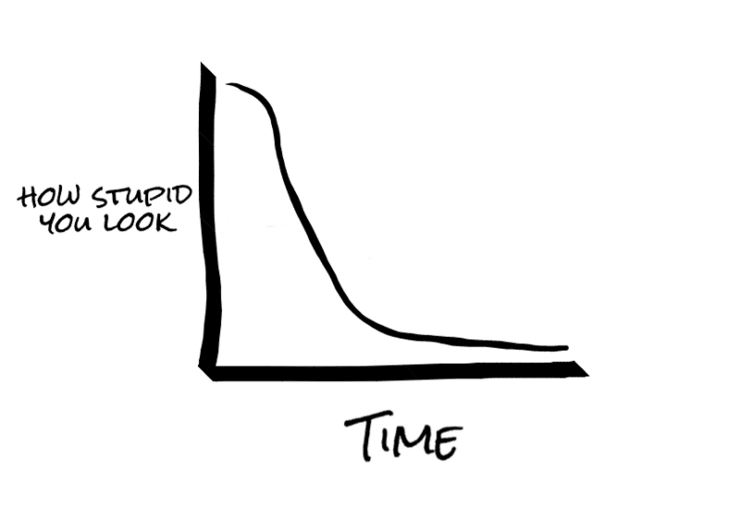
In the real sense, you feel stupid the most when you are newly started on anything, but the more you press in, the less stupid you feel. This is not because the vulnerable feeling suddenly left, but because you've been able to go pasts the awkward feeling, having stayed a little bit longer on the same task. Sadly we often aren't patient enough to see this day.
Have you seen a young child learning how to walk, with confusion all over his face, scared, falling face down many times and crying, but stands to continue trying anyway, here's the reason.

He's not learning how to walk, instead, he's playing with his leg and in love with the fact that his leg could do much more 😀. That little shift in mindset makes all the difference.
Forgetting how learning once began as a play, we all of a sudden begin to seek immediate success in accomplishment, rather than viewing the initial experience as exploration, with no other goal, other than to try things out and have fun along the way.
In the “play-to-learn” framework, the awkwardness you feel should be viewed as a good sign rather than a bad thing. It indicates that you really are onto something new, going in a new direction, learning new things. It is a signpost to a new area open to mastery, an unexplored wilderness of riches.
❤ Things I loved over the week
Quote
“Don’t draw back from that that initial awkwardness but look for it as a welcome harbinger of a new skill. View it as the color that gladdens a gold prospector’s heart, a sign that the mother lode is near and can be found higher up with a bit more effort.”
In Mindset ~ by Carol Dweck
TEDx Show
Known for his very short 3 minutes presentation, Richard shares 4 actionable ways to birth ideas. I bet you've heard them before but I think it's time to begin practising them intentionally.
🎁 Something Different
The prison of your mind | Sean Stephenson | TEDxIronwoodStatePrison
Many things threw me in awe during this presentation, the knowledge shared without any doubt is one, but how much a country is dedicated to reinventing the mindset of their prisoners is a major one.
It can start with you. Look down on no one, use carefully thought through words on anyone and be secure in yourself.
End Note
If you’ve gained value from this issue or the previous issues, kindly consider sharing with like minds within your space.
See you in the next issue, #KeepCreating.
Dami, 👋
Comments
No comments yet.